


Ultimate Guide to Prepare Professional-Data-Engineer Certification Exam for Google Cloud Certified in 2021
Use Real Professional-Data-Engineer Dumps - Google Correct Answers updated on 2021
NEW QUESTION 64
Your company is streaming real-time sensor data from their factory floor into Bigtable and they have
noticed extremely poor performance. How should the row key be redesigned to improve Bigtable
performance on queries that populate real-time dashboards?
- A. Use a row key of the form <timestamp>#<sensorid>.
- B. Use a row key of the form >#<sensorid>#<timestamp>.
- C. Use a row key of the form <timestamp>.
- D. Use a row key of the form <sensorid>.
Answer: C
NEW QUESTION 65
Flowlogistic Case Study
Company Overview
Flowlogistic is a leading logistics and supply chain provider. They help businesses throughout the world manage their resources and transport them to their final destination. The company has grown rapidly, expanding their offerings to include rail, truck, aircraft, and oceanic shipping.
Company Background
The company started as a regional trucking company, and then expanded into other logistics market.
Because they have not updated their infrastructure, managing and tracking orders and shipments has become a bottleneck. To improve operations, Flowlogistic developed proprietary technology for tracking shipments in real time at the parcel level. However, they are unable to deploy it because their technology stack, based on Apache Kafka, cannot support the processing volume. In addition, Flowlogistic wants to further analyze their orders and shipments to determine how best to deploy their resources.
Solution Concept
Flowlogistic wants to implement two concepts using the cloud:
Use their proprietary technology in a real-time inventory-tracking system that indicates the location of
their loads
Perform analytics on all their orders and shipment logs, which contain both structured and unstructured
data, to determine how best to deploy resources, which markets to expand info. They also want to use predictive analytics to learn earlier when a shipment will be delayed.
Existing Technical Environment
Flowlogistic architecture resides in a single data center:
Databases
8 physical servers in 2 clusters
- SQL Server - user data, inventory, static data
3 physical servers
- Cassandra - metadata, tracking messages
10 Kafka servers - tracking message aggregation and batch insert
Application servers - customer front end, middleware for order/customs
60 virtual machines across 20 physical servers
- Tomcat - Java services
- Nginx - static content
- Batch servers
Storage appliances
- iSCSI for virtual machine (VM) hosts
- Fibre Channel storage area network (FC SAN) - SQL server storage
- Network-attached storage (NAS) image storage, logs, backups
Apache Hadoop /Spark servers
- Core Data Lake
- Data analysis workloads
20 miscellaneous servers
- Jenkins, monitoring, bastion hosts,
Business Requirements
Build a reliable and reproducible environment with scaled panty of production.
Aggregate data in a centralized Data Lake for analysis
Use historical data to perform predictive analytics on future shipments
Accurately track every shipment worldwide using proprietary technology
Improve business agility and speed of innovation through rapid provisioning of new resources
Analyze and optimize architecture for performance in the cloud
Migrate fully to the cloud if all other requirements are met
Technical Requirements
Handle both streaming and batch data
Migrate existing Hadoop workloads
Ensure architecture is scalable and elastic to meet the changing demands of the company.
Use managed services whenever possible
Encrypt data flight and at rest
Connect a VPN between the production data center and cloud environment
SEO Statement
We have grown so quickly that our inability to upgrade our infrastructure is really hampering further growth and efficiency. We are efficient at moving shipments around the world, but we are inefficient at moving data around.
We need to organize our information so we can more easily understand where our customers are and what they are shipping.
CTO Statement
IT has never been a priority for us, so as our data has grown, we have not invested enough in our technology. I have a good staff to manage IT, but they are so busy managing our infrastructure that I cannot get them to do the things that really matter, such as organizing our data, building the analytics, and figuring out how to implement the CFO' s tracking technology.
CFO Statement
Part of our competitive advantage is that we penalize ourselves for late shipments and deliveries. Knowing where out shipments are at all times has a direct correlation to our bottom line and profitability.
Additionally, I don't want to commit capital to building out a server environment.
Flowlogistic wants to use Google BigQuery as their primary analysis system, but they still have Apache Hadoop and Spark workloads that they cannot move to BigQuery. Flowlogistic does not know how to store the data that is common to both workloads. What should they do?
- A. Store the common data in BigQuery and expose authorized views.
- B. Store the common data encoded as Avro in Google Cloud Storage.
- C. Store he common data in the HDFS storage for a Google Cloud Dataproc cluster.
- D. Store the common data in BigQuery as partitioned tables.
Answer: A
NEW QUESTION 66
You are deploying a new storage system for your mobile application, which is a media streaming service.
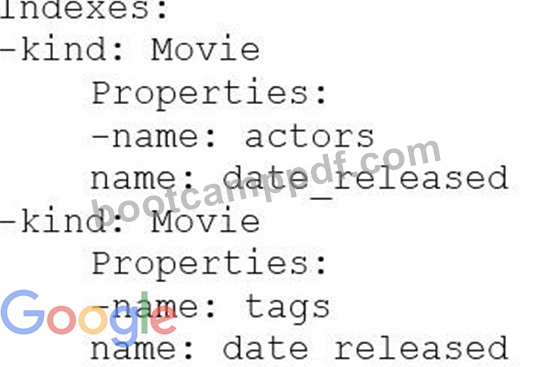
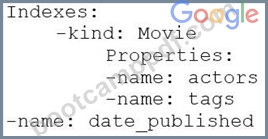
You decide the best fit is Google Cloud Datastore. You have entities with multiple properties, some of which can take on multiple values. For example, in the entity 'Movie'the property 'actors'and the property 'tags' have multiple values but the property 'date released' does not. A typical query would ask for all movies with actor=<actorname>ordered by date_releasedor all movies with tag=Comedyordered by date_released. How should you avoid a combinatorial explosion in the number of indexes?
- A. Manually configure the index in your index config as follows:
- B. Set the following in your entity options: exclude_from_indexes = 'actors, tags'
- C. Set the following in your entity options: exclude_from_indexes = 'date_published'
- D. Manually configure the index in your index config as follows:
Answer: A
NEW QUESTION 67
You are designing the database schema for a machine learning-based food ordering service that will
predict what users want to eat. Here is some of the information you need to store:
The user profile: What the user likes and doesn't like to eat
The user account information: Name, address, preferred meal times
The order information: When orders are made, from where, to whom
The database will be used to store all the transactional data of the product. You want to optimize the data
schema. Which Google Cloud Platform product should you use?
- A. Cloud Datastore
- B. BigQuery
- C. Cloud Bigtable
- D. Cloud SQL
Answer: B
NEW QUESTION 68
You are selecting services to write and transform JSON messages from Cloud Pub/Sub to BigQuery for a data pipeline on Google Cloud. You want to minimize service costs. You also want to monitor and accommodate input data volume that will vary in size with minimal manual intervention. What should you do?
- A. Use Cloud Dataflow to run your transformations. Monitor the total execution time for a sampling of jobs.
Configure the job to use non-default Compute Engine machine types when needed. - B. Use Cloud Dataproc to run your transformations. Use the diagnosecommand to generate an operational output archive. Locate the bottleneck and adjust cluster resources.
- C. Use Cloud Dataflow to run your transformations. Monitor the job system lag with Stackdriver. Use the default autoscaling setting for worker instances.
- D. Use Cloud Dataproc to run your transformations. Monitor CPU utilization for the cluster. Resize the number of worker nodes in your cluster via the command line.
Answer: B
NEW QUESTION 69
Your company produces 20,000 files every hour. Each data file is formatted as a comma separated values (CSV) file that is less than 4 KB. All files must be ingested on Google Cloud Platform before they can be processed. Your company site has a 200 ms latency to Google Cloud, and your Internet connection bandwidth is limited as 50 Mbps. You currently deploy a secure FTP (SFTP) server on a virtual machine in Google Compute Engine as the data ingestion point. A local SFTP client runs on a dedicated machine to transmit the CSV files as is. The goal is to make reports with data from the previous day available to the executives by 10:00 a.m. each day. This design is barely able to keep up with the current volume, even though the bandwidth utilization is rather low. You are told that due to seasonality, your company expects the number of files to double for the next three months. Which two actions should you take? (choose two.)
- A. Contact your internet service provider (ISP) to increase your maximum bandwidth to at least 100 Mbps.
- B. Assemble 1,000 files into a tape archive (TAR) file. Transmit the TAR files instead, and disassemble the CSV files in the cloud upon receiving them.
- C. Introduce data compression for each file to increase the rate file of file transfer.
- D. Create an S3-compatible storage endpoint in your network, and use Google Cloud Storage Transfer Service to transfer on-premices data to the designated storage bucket.
- E. Redesign the data ingestion process to use gsutil tool to send the CSV files to a storage bucket in parallel.
Answer: A,E
NEW QUESTION 70
You are implementing security best practices on your data pipeline. Currently, you are manually executing jobs as the Project Owner. You want to automate these jobs by taking nightly batch files containing non- public information from Google Cloud Storage, processing them with a Spark Scala job on a Google Cloud Dataproc cluster, and depositing the results into Google BigQuery.
How should you securely run this workload?
- A. Restrict the Google Cloud Storage bucket so only you can see the files
- B. Use a service account with the ability to read the batch files and to write to BigQuery
- C. Grant the Project Owner role to a service account, and run the job with it
- D. Use a user account with the Project Viewer role on the Cloud Dataproc cluster to read the batch files and write to BigQuery
Answer: B
NEW QUESTION 71
Cloud Dataproc charges you only for what you really use with _____ billing.
- A. week-by-week
- B. hour-by-hour
- C. minute-by-minute
- D. month-by-month
Answer: C
Explanation:
Explanation
One of the advantages of Cloud Dataproc is its low cost. Dataproc charges for what you really use with minute-by-minute billing and a low, ten-minute-minimum billing period.
Reference: https://cloud.google.com/dataproc/docs/concepts/overview
NEW QUESTION 72
Suppose you have a dataset of images that are each labeled as to whether or not they contain a human face. To create a neural network that recognizes human faces in images using this labeled dataset, what approach would likely be the most effective?
- A. Use K-means Clustering to detect faces in the pixels.
- B. Use deep learning by creating a neural network with multiple hidden layers to automatically detect features of faces.
- C. Use feature engineering to add features for eyes, noses, and mouths to the input data.
- D. Build a neural network with an input layer of pixels, a hidden layer, and an output layer with two categories.
Answer: B
Explanation:
Explanation
Traditional machine learning relies on shallow nets, composed of one input and one output layer, and at most one hidden layer in between. More than three layers (including input and output) qualifies as "deep" learning.
So deep is a strictly defined, technical term that means more than one hidden layer.
In deep-learning networks, each layer of nodes trains on a distinct set of features based on the previous layer's output. The further you advance into the neural net, the more complex the features your nodes can recognize, since they aggregate and recombine features from the previous layer.
A neural network with only one hidden layer would be unable to automatically recognize high-level features of faces, such as eyes, because it wouldn't be able to "build" these features using previous hidden layers that detect low-level features, such as lines.
Feature engineering is difficult to perform on raw image data.
K-means Clustering is an unsupervised learning method used to categorize unlabeled data.
Reference: https://deeplearning4j.org/neuralnet-overview
NEW QUESTION 73
Flowlogistic wants to use Google BigQuery as their primary analysis system, but they still have Apache Hadoop and Spark workloads that they cannot move to BigQuery. Flowlogistic does not know how to store the data that is common to both workloads. What should they do?
- A. Store the common data in BigQuery and expose authorized views.
- B. Store the common data encoded as Avro in Google Cloud Storage.
- C. Store he common data in the HDFS storage for a Google Cloud Dataproc cluster.
- D. Store the common data in BigQuery as partitioned tables.
Answer: A
NEW QUESTION 74
If a dataset contains rows with individual people and columns for year of birth, country, and income, how many of the columns are continuous and how many are categorical?
- A. 3 categorical
- B. 1 continuous and 2 categorical
- C. 3 continuous
- D. 2 continuous and 1 categorical
Answer: D
Explanation:
Explanation
The columns can be grouped into two types-categorical and continuous columns:
A column is called categorical if its value can only be one of the categories in a finite set. For example, the native country of a person (U.S., India, Japan, etc.) or the education level (high school, college, etc.) are categorical columns.
A column is called continuous if its value can be any numerical value in a continuous range. For example, the capital gain of a person (e.g. $14,084) is a continuous column.
Year of birth and income are continuous columns. Country is a categorical column.
You could use bucketization to turn year of birth and/or income into categorical features, but the raw columns are continuous.
Reference: https://www.tensorflow.org/tutorials/wide#reading_the_census_data
NEW QUESTION 75
You have a requirement to insert minute-resolution data from 50,000 sensors into a BigQuery table. You expect significant growth in data volume and need the data to be available within 1 minute of ingestion for real-time analysis of aggregated trends. What should you do?
- A. Use bq load to load a batch of sensor data every 60 seconds.
- B. Use a Cloud Dataflow pipeline to stream data into the BigQuery table.
- C. Use the MERGE statement to apply updates in batch every 60 seconds.
- D. Use the INSERT statement to insert a batch of data every 60 seconds.
Answer: B
NEW QUESTION 76
You are a head of BI at a large enterprise company with multiple business units that each have different priorities and budgets. You use on-demand pricing for BigQuery with a quota of 2K concurrent on-demand slots per project. Users at your organization sometimes don't get slots to execute their query and you need to correct this. You'd like to avoid introducing new projects to your account.
What should you do?
- A. Switch to flat-rate pricing and establish a hierarchical priority model for your projects.
- B. Increase the amount of concurrent slots per project at the Quotas page at the Cloud Console.
- C. Convert your batch BQ queries into interactive BQ queries.
- D. Create an additional project to overcome the 2K on-demand per-project quota.
Answer: A
Explanation:
Explanation/Reference:
Reference https://cloud.google.com/blog/products/gcp/busting-12-myths-about-bigquery
NEW QUESTION 77
You use a dataset in BigQuery for analysis. You want to provide third-party companies with access to the same dataset. You need to keep the costs of data sharing low and ensure that the data is current. Which solution should you choose?
- A. Create a Cloud Dataflow job that reads the data in frequent time intervals, and writes it to the relevant BigQuery dataset or Cloud Storage bucket for third-party companies to use.
- B. Create an authorized view on the BigQuery table to control data access, and provide third-party companies with access to that view.
- C. Use Cloud Scheduler to export the data on a regular basis to Cloud Storage, and provide third-party companies with access to the bucket.
- D. Create a separate dataset in BigQuery that contains the relevant data to share, and provide third-party companies with access to the new dataset.
Answer: C
Explanation:
Explanation
NEW QUESTION 78
What Dataflow concept determines when a Window's contents should be output based on certain criteria being met?
- A. Sessions
- B. Windows
- C. Triggers
- D. OutputCriteria
Answer: C
Explanation:
Triggers control when the elements for a specific key and window are output. As elements arrive, they are put into one or more windows by a Window transform and its associated WindowFn, and then passed to the associated Trigger to determine if the Windows contents should be output.
Reference: https://cloud.google.com/dataflow/java-
sdk/JavaDoc/com/google/cloud/dataflow/sdk/transforms/windowing/Trigger
NEW QUESTION 79
Which of these are examples of a value in a sparse vector? (Select 2 answers.)
- A. [0, 1]
- B. [0, 5, 0, 0, 0, 0]
- C. [0, 0, 0, 1, 0, 0, 1]
- D. [1, 0, 0, 0, 0, 0, 0]
Answer: A,D
Explanation:
Explanation
Categorical features in linear models are typically translated into a sparse vector in which each possible value has a corresponding index or id. For example, if there are only three possible eye colors you can represent
'eye_color' as a length 3 vector: 'brown' would become [1, 0, 0], 'blue' would become [0, 1, 0] and 'green' would become [0, 0, 1]. These vectors are called "sparse" because they may be very long, with many zeros, when the set of possible values is very large (such as all English words).
[0, 0, 0, 1, 0, 0, 1] is not a sparse vector because it has two 1s in it. A sparse vector contains only a single 1.
[0, 5, 0, 0, 0, 0] is not a sparse vector because it has a 5 in it. Sparse vectors only contain 0s and 1s.
Reference: https://www.tensorflow.org/tutorials/linear#feature_columns_and_transformations
NEW QUESTION 80
Your company uses a proprietary system to send inventory data every 6 hours to a data ingestion service in the cloud. Transmitted data includes a payload of several fields and the timestamp of the transmission. If there are any concerns about a transmission, the system re-transmits the data. How should you deduplicate the data most efficiency?
- A. Assign global unique identifiers (GUID) to each data entry.
- B. Store each data entry as the primary key in a separate database and apply an index.
- C. Maintain a database table to store the hash value and other metadata for each data entry.
- D. Compute the hash value of each data entry, and compare it with all historical data.
Answer: C
NEW QUESTION 81
You decided to use Cloud Datastore to ingest vehicle telemetry data in real time. You want to build a storage system that will account for the long-term data growth, while keeping the costs low. You also want to create snapshots of the data periodically, so that you can make a point-in-time (PIT) recovery, or clone a copy of the data for Cloud Datastore in a different environment. You want to archive these snapshots for a long time.
Which two methods can accomplish this? (Choose two.)
- A. Write an application that uses Cloud Datastore client libraries to read all the entities. Format the exported data into a JSON file. Apply compression before storing the data in Cloud Source Repositories.
- B. Use managed export, and then import to Cloud Datastore in a separate project under a unique namespace reserved for that export.
- C. Use managed export, and then import the data into a BigQuery table created just for that export, and delete temporary export files.
- D. Write an application that uses Cloud Datastore client libraries to read all the entities. Treat each entity as a BigQuery table row via BigQuery streaming insert. Assign an export timestamp for each export, and attach it as an extra column for each row. Make sure that the BigQuery table is partitioned using the export timestamp column.
- E. Use managed export, and store the data in a Cloud Storage bucket using Nearline or Coldline class.
Answer: A,C
NEW QUESTION 82
Cloud Dataproc is a managed Apache Hadoop and Apache _____ service.
- A. Fire
- B. Blaze
- C. Spark
- D. Ignite
Answer: C
Explanation:
Cloud Dataproc is a managed Apache Spark and Apache Hadoop service that lets you use open source data tools for batch processing, querying, streaming, and machine learning.
Reference: https://cloud.google.com/dataproc/docs/
NEW QUESTION 83
To run a TensorFlow training job on your own computer using Cloud Machine Learning Engine, what would your command start with?
- A. You can't run a TensorFlow program on your own computer using Cloud ML Engine .
- B. gcloud ml-engine jobs submit training local
- C. gcloud ml-engine local train
- D. gcloud ml-engine jobs submit training
Answer: C
Explanation:
Explanation
gcloud ml-engine local train - run a Cloud ML Engine training job locally This command runs the specified module in an environment similar to that of a live Cloud ML Engine Training Job.
This is especially useful in the case of testing distributed models, as it allows you to validate that you are properly interacting with the Cloud ML Engine cluster configuration.
Reference: https://cloud.google.com/sdk/gcloud/reference/ml-engine/local/train
NEW QUESTION 84
You are working on a niche product in the image recognition domain. Your team has developed a model that is dominated by custom C++ TensorFlow ops your team has implemented. These ops are used inside your main training loop and are performing bulky matrix multiplications. It currently takes up to several days to train a model. You want to decrease this time significantly and keep the cost low by using an accelerator on Google Cloud. What should you do?
- A. Stay on CPUs, and increase the size of the cluster you're training your model on.
- B. Use Cloud TPUs without any additional adjustment to your code.
- C. Use Cloud GPUs after implementing GPU kernel support for your customs ops.
- D. Use Cloud TPUs after implementing GPU kernel support for your customs ops.
Answer: D
NEW QUESTION 85
Your company's customer and order databases are often under heavy load. This makes performing analytics against them difficult without harming operations. The databases are in a MySQL cluster, with nightly backups taken using mysqldump. You want to perform analytics with minimal impact on operations.
What should you do?
- A. Add a node to the MySQL cluster and build an OLAP cube there.
- B. Mount the backups to Google Cloud SQL, and then process the data using Google Cloud Dataproc.
- C. Use an ETL tool to load the data from MySQL into Google BigQuery.
- D. Connect an on-premises Apache Hadoop cluster to MySQL and perform ETL.
Answer: D
NEW QUESTION 86
You are using Google BigQuery as your data warehouse. Your users report that the following simple query is running very slowly, no matter when they run the query:
SELECT country, state, city FROM [myproject:mydataset.mytable] GROUP BY country You check the query plan for the query and see the following output in the Read section of Stage:1:
What is the most likely cause of the delay for this query?
- A. Most rows in the [myproject:mydataset.mytable] table have the same value in the country column, causing data skew
- B. Users are running too many concurrent queries in the system
- C. Either the state or the city columns in the [myproject:mydataset.mytable] table have too many NULL values
- D. The [myproject:mydataset.mytable] table has too many partitions
Answer: B
NEW QUESTION 87
......
Google Cloud Certified -Professional-Data-Engineer Exam-Practice-Dumps: https://www.bootcamppdf.com/Professional-Data-Engineer_exam-dumps.html
Professional-Data-Engineer Premium Files Test pdf - Free Dumps Collection: https://drive.google.com/open?id=1_23w5UdJEt2xMCGDeQuTpMnKHLewSjw-