


Latest [Feb 15, 2025] 100% Passing Guarantee - Brilliant OGBA-101 Exam Questions PDF
OGBA-101 Certification – Valid Exam Dumps Questions Study Guide! (Updated 109 Questions)
The Open Group OGBA-101 Exam Syllabus Topics:
| Topic | Details |
|---|---|
| Topic 1 |
|
| Topic 2 |
|
| Topic 3 |
|
| Topic 4 |
|
| Topic 5 |
|
| Topic 6 |
|
| Topic 7 |
|
NEW QUESTION # 24
Exhibit.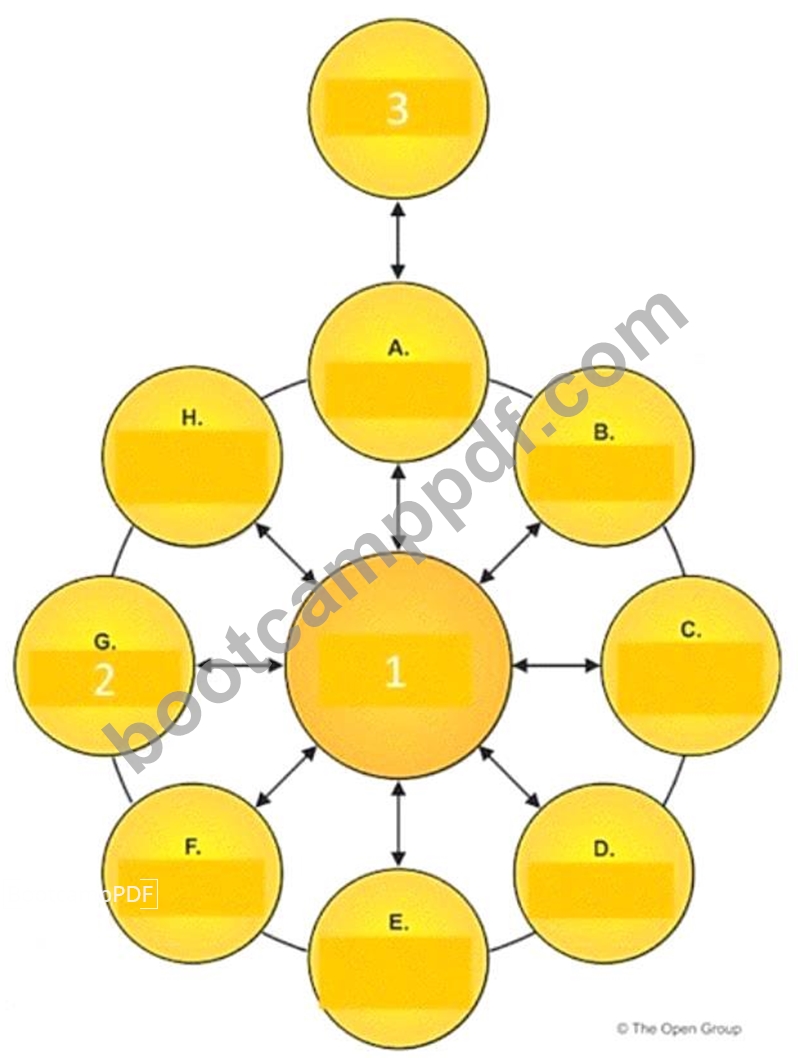
Consider the diagram of an architecture development cycle.
Select the correct phase names corresponding to the labels 1, 2 and 3?
- A. 1 Requirements Management - 2 Implementation Governance - 3 Preliminary
- B. 1 Requirements Management - 2 Change Management - 3 Strategy
- C. 1 Continuous Improvement - 2 Migration Planning - 3 Architecture Vision
- D. 1 Architecture Governance - 2 Implementation Governance - 3 Preliminary
Answer: A
Explanation:
The diagram of an architecture development cycle shows three phases of the TOGAF ADM. The correct phase names corresponding to the labels 1, 2 and 3 are Requirements Management, Implementation Governance, and Preliminary respectively3. These phases are described as follows:
* Requirements Management (label 1): This phase provides a process for managing architecture requirements throughout the ADM cycle3. It ensures that requirements are captured, stored, prioritized, and addressed by relevant ADM phases3. It also ensures that requirements are validated and updated as necessary3.
* Implementation Governance (label 2): This phase provides a process for ensuring that the implementation projects conform to the defined architecture3. It involves establishing an implementation governance model, defining architecture contracts and compliance reviews, and monitoring and supporting the implementation projects3.
* Preliminary (label 3): This phase provides a process for preparing and planning the architecture project3. It involves defining the scope and vision of the project, customizing the ADM process and content framework, defining principles and governance structures, and evaluating the enterprise architecture maturity and readiness3.
NEW QUESTION # 25
Which ADM phase focuses on defining the problem to be solved, identifying the stakeholders, their concerns, and requirements?
- A. Phase A
- B. Phase C
- C. Preliminary Phase
- D. Phase B
Answer: A
Explanation:
Phase A of the TOGAF ADM (Architecture Development Method), also known as the Architecture Vision phase, focuses on defining the problem to be solved, identifying stakeholders, their concerns, and requirements. Here's a detailed explanation:
Phase A: Architecture Vision:
Objective: The primary objective of Phase A is to establish a high-level vision of the architecture project, including defining the scope and identifying key stakeholders and their concerns.
Problem Definition: This phase involves clearly defining the business problem or opportunity that the architecture project seeks to address. This sets the stage for all subsequent architecture work.
Stakeholder Identification:
Identification and Analysis: Stakeholders are identified and their concerns and requirements are gathered. This includes business leaders, IT leaders, end-users, and other relevant parties.
Understanding Needs: Understanding the needs and expectations of stakeholders is crucial for ensuring that the architecture aligns with business objectives and addresses key concerns.
Requirements Gathering:
High-Level Requirements: In Phase A, high-level requirements are identified and documented. These requirements guide the development of the architecture vision and provide a basis for more detailed requirements in later phases.
Requirements Management: A requirements management process is established to ensure that stakeholder needs are continuously captured, analyzed, and addressed throughout the architecture development process.
TOGAF References:
Deliverables: Key deliverables of Phase A include the Architecture Vision document, stakeholder map, and high-level requirements.
ADM Guidelines: TOGAF provides guidelines and techniques for conducting Phase A, including methods for stakeholder analysis, problem definition, and developing the architecture vision.
In summary, Phase A of the TOGAF ADM focuses on defining the problem to be solved, identifying stakeholders, understanding their concerns and requirements, and developing a high-level architecture vision that aligns with business objectives.
NEW QUESTION # 26
Which of the following best summarizes the purpose of Enterprise Architecture?
- A. Controlling the bigger changes.
- B. Guiding effective change.
- C. Taking major improvement decisions.
- D. Governing the Stakeholders.
Answer: B
Explanation:
The purpose of Enterprise Architecture, within the context of TOGAF, is to establish a clear and comprehensive blueprint for how an organization can effectively achieve its current and future objectives through a structured approach. Enterprise Architecture guides effective change by providing a long-term view of the organization's processes, systems, and technologies so that individual projects can build capabilities that fit into a cohesive whole. It helps to ensure that IT investments are aligned with business goals, supports the management of complex IT landscapes, and provides a systematic approach for the adoption of emerging technologies. Essentially, it acts as a strategic framework that facilitates the translation of business vision and strategy into effective enterprise change.
NEW QUESTION # 27
Which of the following is a benefit of Value Stream Mapping?
- A. It helps to ensure that investments and project initiatives are prioritized and funded at a level matching with their value.
- B. It highlights the value of individual work packages needed to develop the business architecture.
- C. It helps to assess an organization's effectiveness at creating, capturing, and delivering value for different stakeholders.
- D. It helps to identify value, duplication, and redundancy across the enterprise.
Answer: C
Explanation:
Value Stream Mapping (VSM) is a powerful tool used to assess an organization's effectiveness at creating, capturing, and delivering value for different stakeholders. It involves mapping out the entire process of value creation from end to end, identifying each step involved, and analyzing how value is added at each stage.
VSM helps in identifying bottlenecks, inefficiencies, and opportunities for improvement, ultimately aiming to optimize the value delivery process to better meet stakeholder needs.
NEW QUESTION # 28
Refer to the table below:
Which ADM Phase(s) does this describe?
- A. Phase E
- B. Preliminary Phase
- C. Phase B
- D. Phase B. C and D
Answer: D
Explanation:
The table describes the steps involved in Phase B (Business Architecture), Phase C (Information Systems Architectures), and Phase D (Technology Architecture) of the TOGAF ADM5. These phases are responsible for developing the target architectures for each domain and identifying the gaps between the baseline and target architectures. The table shows the outputs and outcomes of each phase, as well as the essential knowledge required for each phase.
NEW QUESTION # 29
What Is presented as striking a balance between positive and negative outcomes resulting from the realization of either opportunities or threats"?
- A. Risk Management
- B. Transition Management
- C. Agile development
- D. Architecture Security
Answer: A
Explanation:
Risk Management is the discipline that addresses the identification, assessment, and prioritization of risks followed by coordinated application of resources to minimize, control, and monitor the impact of unfortunate events or to maximize the realization of opportunities. It is about striking a balance between the positive outcomes of opportunities and the negative outcomes of risks, ensuring that the enterprise can achieve its objectives while keeping potential threats under control.
NEW QUESTION # 30
What are the four architecture domains that the TOGAF standard deals with?
- A. Application, Data, Information, Knowledge
- B. Capability, Segment, Enterprise, Federated
- C. Business, Data, Application, Technology
- D. Baseline, Candidate, Transition, Target
Answer: C
Explanation:
TOGAF defines four core architecture domains: Business, Data, Application, and Technology. These domains collectively represent the key areas covered in enterprise architecture, where the Business Architecture defines business strategy and organizational goals; Data Architecture addresses data management and structure; Application Architecture focuses on system and software applications; and Technology Architecture outlines the IT infrastructure.
References: TOGAF Standard, Architecture Domains (Chapter 3).
TOGAF, as a comprehensive Enterprise Architecture framework, divides the architecture landscape into four interrelated domains:
* Business Architecture:This domain focuses on the organization's strategic goals, business processes, and organizational structure. It defines how the business operates and creates value.
* Data Architecture:This domain deals with the structure, organization, and management of data assets within the enterprise. It includes logical and physical data models, data storage, and data security.
* Application Architecture:This domain describes the applications used to support the business, their interactions, and their alignment with business processes. It provides a blueprint for the application portfolio.
* Technology Architecture:This domain covers the technology infrastructure that supports the applications and data. It includes hardware, software, networks, and IT services.
These four domains provide a holistic view of the enterprise and how its different components work together.
NEW QUESTION # 31
Which of the following is the element of a value stream stage that describes the end state condition denoting the completion of the value stream stage?
- A. Exit criteria
- B. Target state
- C. Completion stage
- D. End point
Answer: A
Explanation:
In TOGAF's Business Architecture, a value stream stage is a high-level representation of a sequence of activities that create value for an organization. The end state condition denoting the completion of a value stream stage is known as the "Exit Criteria." This term is used to specify the conditions that must be met for the stage to be considered complete, ensuring that the output meets the required quality and performance standards before progressing to the next stage. The concept of "Exit Criteria" is essential to ensure that each stage of the value stream adds the expected value and aligns with the overall business objectives.
NEW QUESTION # 32
What process turns a set of business capabilities into a structure that communicates the right amount of detail to different stakeholder groups?
- A. Categorization
- B. Stratification
- C. Mapping
- D. Layering
Answer: C
Explanation:
Mapping is the process that turns a set of business capabilities into a structure that communicates the right amount of detail to different stakeholder groups. Here's a detailed explanation:
* Definition of Mapping:
* Mapping: In the context of business architecture, mapping refers to the process of visually representing the relationships between business capabilities and other elements such as processes, value streams, and organizational units. This helps in communicating the structure and interactions within the business.
* Purpose:
* Communication: Mapping provides a clear and structured way to communicate the details of business capabilities to different stakeholder groups. It ensures that each group receives the appropriate level of detail needed for their role and decision-making.
* Alignment: Helps in aligning business capabilities with strategic goals, processes, and organizational structure, ensuring that the architecture supports the overall business strategy.
* TOGAF References:
* Phase B: Business Architecture: During this phase, mapping is used to represent business capabilities and their relationships with other business elements. This helps in creating a coherent and comprehensive business architecture.
* Capability Mapping: TOGAF emphasizes the use of capability mapping to understand and analyze how different capabilities support business processes and value streams.
* Benefits:
* Clarity and Understanding: Mapping provides a visual representation that enhances clarity and understanding of the business architecture. It helps stakeholders see the big picture and understand how different parts of the business fit together.
* Stakeholder Engagement: By providing the right amount of detail to different stakeholders, mapping ensures effective engagement and collaboration across the organization.
In summary, mapping is the process that turns a set of business capabilities into a structure that communicates the right amount of detail to different stakeholder groups, facilitating clarity, understanding, and alignment.
NEW QUESTION # 33
Which of the following is an analysis technique which is used to show a range of different perspectives on the same set of business capabilities?
- A. Capability decomposition
- B. Heat mapping
- C. Information mapping
- D. Relationship mapping
Answer: B
Explanation:
Heat mapping is an analysis technique used to provide a visual representation of data, often to show performance against a set of criteria. In the context of business capabilities, heat maps can be used to represent various dimensions such as maturity levels, investment priorities, risk levels, etc., on the same set of business capabilities. This allows different stakeholders to quickly grasp where attention is needed or how capabilities align with strategic priorities.
NEW QUESTION # 34
Consider the diagram.
What are the items labelled A, B and C?
- A. A-Enterprise Continuum, B-Architecture Continuum. C-Solutions Continuum
- B. A-Enterprise Architecture, B-Architecture Building Blocks, C-Solutions Building Blocks
- C. A-Architecture Vision, B-Business Architecture. C-lnformation Systems Architecture
- D. A-Enterprise Strategic Architecture, B-Segment Architecture, C-Solutions Architecture
Answer: A
Explanation:
The diagram shows the Enterprise Continuum, which is a view of the Architecture Repository that provides methods for classifying architecture and solution artifacts as they evolve from generic Foundation Architectures to Organization-Specific Architectures4. The Enterprise Continuum comprises two complementary concepts: the Architecture Continuum and the Solutions Continuum. The Architecture Continuum shows the relationships among foundational frameworks, common system architectures, industry architectures, and enterprisearchitectures4. The Solutions Continuum shows the relationships among foundational solutions, common system solutions, industry solutions, and enterprise solutions4.
NEW QUESTION # 35
What component of the Architecture Repository is an architectural representation of SBBs supporting the Architecture Landscape?
- A. Solutions Landscape
- B. Solutions Library
- C. Solutions Repository
- D. Solutions Continuum
Answer: D
Explanation:
In the context of the TOGAF Architecture Repository, the Solutions Continuum represents an architectural representation of Solution Building Blocks (SBBs) supporting the Architecture Landscape. It provides a view of the available and implemented solutions that can be used or adapted for new initiatives.
NEW QUESTION # 36
Which of the following best describes a business capability map?
- A. A holistic representation of capabilities, including end-to-end delivery value, and the relationships between these capabilities.
- B. The highest-level description of an organization, covering all missions and functions of the business.
- C. A reference model that provides a c onceptual definition of all the key building blocks within a business architecture
- D. A self-contained view of the business that is independent of organizational structure, business processes, systems and applications.
Answer: A
Explanation:
A business capability map is a comprehensive representation that showcases an organization's abilities in a structured manner. It identifies and illustrates the various business capabilities that allow the enterprise to function and deliver value. These capabilities are often defined independently of the organizational structure, processes, or technology, focusing instead on what the business does and can do. This map encompasses the end-to-end value delivery and how different capabilities interrelate and support one another, thus providing a holistic view of the business's functional abilities.
NEW QUESTION # 37
Which of the following best describes a business capability?
- A. It delineates what a business does without an explanation of how, why, or where the capability is used.
- B. It is an articulation of the relationships between business entities that make up the enterprise.
- C. It is a qualitative statement of intent that should be met by the enterprise architecture capability developing the business architecture.
- D. It is a detailed description of the architectural approach to realize a particular solution.
Answer: A
Explanation:
In TOGAF, a business capability represents a high-level abstraction of what a business does, independent of how, why, or where the capability is used. Here's a detailed explanation:
* Definition of Business Capability:
* Business Capability: A business capability describes the capacity or ability of a business to act or achieve a specific outcome. It is an abstraction of the business functions, representing what the business does.
* Key Characteristics:
* What, Not How: A business capability focuses on what the business does, without delving into the specifics of how, why, or where it is implemented or utilized. This abstraction helps in maintaining a clear and consistent understanding across the organization.
* Independence: Business capabilities are designed to be independent of the organizational
* structure, processes, or systems that support them. This ensures that they remain stable even as the organization evolves.
* TOGAF References:
* Phase B: Business Architecture: In this phase, business capabilities are identified and mapped to understand the core functions of the business. This helps in aligning the architecture with business strategy and objectives.
* Capability-Based Planning: TOGAF emphasizes capability-based planning, where business capabilities are used as the foundation for planning and decision-making.
* Importance:
* Strategic Alignment: Business capabilities provide a stable and consistent view of what the business does, which is crucial for aligning the architecture with strategic goals.
* Foundation for Analysis: By focusing on what the business does, capabilities serve as a foundation for various analyses, including gap analysis, impact analysis, and capability maturity assessments.
In summary, a business capability delineates what a business does without an explanation of how, why, or where the capability is used, providing a stable and consistent foundation for strategic planning and architecture development.
NEW QUESTION # 38
Which of the following is a purpose of mapping capabilities to value stream stages?
- A. To describe the business in terms of services provided and consumed.
- B. To classify, group, and align capabilities into categories for a deeper understanding.
- C. To provide a self-contained business description that is independent of the organizational structure.
- D. To identify and eliminate business capabilities that do not contribute to the business.
Answer: B
Explanation:
One of the purposes of mapping capabilities to value stream stages is to classify, group, and align capabilities into categories for a deeper understanding of how they support value creation and delivery2. By mapping capabilities to value stream stages, the architect can identify which capabilities are required for each stage of the value stream, how they relate to each other, and how they contribute to the overall value proposition. This can help to assess the maturity, effectiveness, performance, and value or cost contribution of each capability.
NEW QUESTION # 39
Complete the sentence. The TOGAF standard covers the development of four architecture domains. Business. Dat a. Technology and___________.
- A. Transition
- B. Capability
- C. Application
- D. Segment
Answer: C
Explanation:
The TOGAF standard covers the development of four architecture domains: Business, Data, Technology, and Application. The Application Architecture domain defines the applications required to process the data and support the business functions.
The TOGAF standard describes the development of four architecture domains, which are considered its pillars. These are Business, Data, Technology, and Application. The Application Architecture domain provides a blueprint for the individual application systems to be deployed, their interactions, and their relationships to the core business processes of the organization.
NEW QUESTION # 40
Which of the following is a benefit of organization mapping?
- A. An organization map improves strategic planning.
- B. An organization map improves the ability to consume, process, and deliver information.
- C. An organization map can be reused for training and employee development.
- D. An organization map highlights inefficiencies and reduces operational costs.
Answer: A
Explanation:
One of the benefits of organization mapping is that it improves strategic planning2. Organization mapping is a technique that can be used to document and visualize the organizational structure and relationships of an enterprise or a part of it2. Organization mapping can help to align the organizational design with the business strategy, goals, and objectives2. Organization mapping can also help to identify the roles, responsibilities, authorities, accountabilities, and dependencies of different organizational entities2. By providing a clear and consistent view of the organizational landscape, organization mapping can enable better informed and more effective decisions for strategic planning.
NEW QUESTION # 41
In business capability mapping, when you have documented all of the business capabilities, what should you do next?
- A. Organize the business capabilities in a logical manner.
- B. Identify the human and computer actors associated with each business capability.
- C. Map the business capabilities to stakeholder concerns.
- D. Draw up a business value assessment for each of the business capabilities.
Answer: A
Explanation:
In business capability mapping, once all business capabilities have been documented, the next step is to organize these capabilities logically. This organization helps in understanding how different capabilities interact and align with the business strategy. Here's a detailed explanation based on TOGAF principles:
Business Capability Mapping:
Business capability mapping involves identifying and documenting the capabilities required to execute the business strategy. Capabilities are the building blocks of the business, representing what the business does.
Logical Organization:
Grouping and Categorization: Capabilities should be grouped and categorized logically to reflect their relationships and dependencies. This can be done by aligning capabilities with business functions, processes, or strategic objectives.
Hierarchical Structure: Organizing capabilities into a hierarchical structure helps in visualizing how high-level capabilities decompose into more specific, detailed capabilities. This hierarchical view aids in understanding the complexity and scope of capabilities.
Alignment with Strategy: Logical organization ensures that capabilities are aligned with the business strategy and objectives. It helps in identifying which capabilities are critical for achieving strategic goals and which ones need development or improvement.
TOGAF ADM References:
Phase B: Business Architecture: This phase involves developing the business architecture, including capability mapping. Organizing capabilities logically is a key step in this process, as it helps in creating a coherent and comprehensive business architecture.
Capability Models: TOGAF recommends using capability models to represent the organization's capabilities.
These models should be logically organized to facilitate analysis and planning.
Practical Steps:
Analyze Relationships: Examine the relationships between capabilities to identify dependencies and interactions. This analysis helps in grouping related capabilities together.
Create a Capability Map: Develop a visual representation of the capabilities, organized logically. This map serves as a reference for understanding the business architecture and planning initiatives.
In summary, after documenting all business capabilities, organizing them in a logical manner is essential for creating a coherent and effective business architecture. This logical organization facilitates better analysis, planning, and alignment with business strategy.
NEW QUESTION # 42
When developing a Business Architecture, which of the following best describes the approach to take If no Architecture Descriptions exist?
- A. Identify the business goals, business objectives, and drivers for the enterprise
- B. Review the contents of the Architecture Repository.
- C. Validate the business principles and update the Statement of Architecture Work.
- D. Information should be gathered, and Business Architecture models developed.
Answer: D
Explanation:
In the absence of existing Architecture Descriptions, the development of a Business Architecture would begin with the gathering of relevant information about the business. This information can come from strategic documents, business plans, process documents, and stakeholder interviews, among other sources. Once gathered, this information would be used to create Business Architecture models that articulate the business vision, strategy, governance, organization, and key business processes. These models provide a blueprint that captures the essence of the business and guides subsequent architecture work.
NEW QUESTION # 43
......
OGBA-101 are Available for Instant Access: https://www.bootcamppdf.com/OGBA-101_exam-dumps.html
OGBA-101 Dumps 2025 - New The Open Group OGBA-101 Exam Questions: https://drive.google.com/open?id=1fYLGGvqgR3Oa1jjjMTjoMycJ8cJd18ij