


Authentic Best resources for AZ-104 Test Engine Practice Exam
[2021] AZ-104 PDF Questions - Perfect Prospect To Go With BootcampPDF Practice Exam
NEW QUESTION 90
You have an Azure subscription that contains the virtual machines shown in the following table:
VM1 and VM2 use public IP addresses. From Windows Server 2019 on VM1 and VM2, you allow inbound Remote Desktop connections.
Subnet1 and Subnet2 are in a virtual network named VNET1.
The subscription contains two network security groups (NSGs) named NSG1 and NSG2. NSG1 uses only the default rules.
NSG2 uses the default rules and the following custom incoming rule:
Priority: 100
Name: Rule1
Port: 3389
Protocol: TCP
Source: Any
Destination: Any
Action: Allow
NSG1 is associated to Subnet1. NSG2 is associated to the network interface of VM2.
For each of the following statements, select Yes if the statement is true. Otherwise, select No.
NOTE: Each correct selection is worth one point.
Answer:
Explanation:
References:
https://docs.microsoft.com/en-us/azure/virtual-machines/troubleshooting/troubleshoot-rdp-connection
NEW QUESTION 91
You create a virtual machine scale set named Scale1. Scale1 is configured as shown in the following exhibit.
Use the drop-down menus to select the answer choice that completes each statement based on the information presented in the graphic.
Answer:
Explanation:
Explanation
Box 1:
The Autoscale scale out rule increases the number of VMs by 2 if the CPU threshold is 80% or higher. The initial instance count is 4 and rises to 6 when the 2 extra instances of VMs are added.
Box 2:
The Autoscale scale in rule decreases the number of VMs by 4 if the CPU threshold is 30% or lower. The initial instance count is 4 and thus cannot be reduced to 0 as the minimum instances is set to 2. Instances are only added when the CPU threshold reaches 80%.
References:
https://docs.microsoft.com/en-us/azure/azure-monitor/platform/autoscale-overview
https://docs.microsoft.com/en-us/azure/azure-monitor/platform/autoscale-best-practices
https://docs.microsoft.com/en-us/azure/azure-monitor/platform/autoscale-common-scale-patterns
NEW QUESTION 92
You have an Azure virtual machine named VM1 that connects to a virtual network named VNet1. VM1 has the following configurations:
* Subnet: 10.0.0.0/24
* Availability set: AVSet
* Network security group (NSG): None
* Private IP address: 10.0.0.4 (dynamic)
* Public IP address: 40.90.219.6 (dynamic)
You deploy a standard, Internet-facing load balancer named slb1.
You need to configure slb1 to allow connectivity to VM1.
Which changes should you apply to VM1 as you configure slb1? To answer, select the appropriate options in the answer area.
NOTE: Each correct selection is worth one point.
Answer:
Explanation:
Explanation
Box 1: Remove the public IP address from VM1
If the Public IP on VM1 is set to Dynamic, that means it is a Public IP with Basic SKU because Public IPs with Standard SKU have Static assignments by default, that cannot be changed. We cannot associate Basic SKUs IPs with Standard SKUs LBs. One cannot create a backend SLB pool if the VM to be associated has a Public IP. For Private IP it doesn't matter weather it is dynamic or static, still we can add the such VM into the SLB backend pool.
Box 2: Create and configure an NSG
Standard Load Balancer is built on the zero trust network security model at its core. Standard Load Balancer secure by default and is part of your virtual network. The virtual network is a private and isolated network.
This means Standard Load Balancers and Standard Public IP addresses are closed to inbound flows unless opened by Network Security Groups. NSGs are used to explicitly permit allowed traffic. If you do not have an NSG on a subnet or NIC of your virtual machine resource, traffic is not allowed to reach this resource. To learn more about NSGs and how to apply them for your scenario, see Network Security Groups. Basic Load Balancer is open to the internet by default.
Reference:
https://docs.microsoft.com/en-us/azure/load-balancer/quickstart-load-balancer-standard-public-portal
https://docs.microsoft.com/en-us/azure/load-balancer/load-balancer-overview
NEW QUESTION 93
You have the Azure virtual network named VNet1 that contains a subnet named Subnet1. Subnet1 contains three Azure virtual machines. Each virtual machine has a public IP address.
The virtual machines host several applications that are accessible over port 443 to users on the Internet.
Your on-premises network has a site-to-site VPN connection to VNet1.
You discover that the virtual machines can be accessed by using the Remote Desktop Protocol (RDP) from the Internet and from the on-premises network.
You need to prevent RDP access to the virtual machines from the Internet, unless the RDP connection is established from the on-premises network. The solution must ensure that all the applications can still be accessed by the Internet users.
What should you do?
- A. Modify the address space of Subnet1
- B. Modify the address space of the local network gateway
- C. Remove the public IP addresses from the virtual machines
- D. Create a deny rule in a network security group (NSG) that is linked to Subnet1
Answer: D
Explanation:
You can use a site-to-site VPN to connect your on-premises network to an Azure virtual network. Users on your on-premises network connect by using the RDP or SSH protocol over the site-to-site VPN connection. You don't have to allow direct RDP or SSH access over the internet.
Reference:
https://docs.microsoft.com/en-us/azure/security/fundamentals/network-best-practices
NEW QUESTION 94
You have an Azure virtual machine mat runs Windows Server 2019 and has the following configurations:
* Name:VM1
* Location: Welt US
* Connected to: VNfT1
* Private IP address: 10.1.0.4
* Public IP address: 52 18685.63
* DNS suffix m Windows Server.Adatum.com
You create the Azure DNS zones shown in the following table.
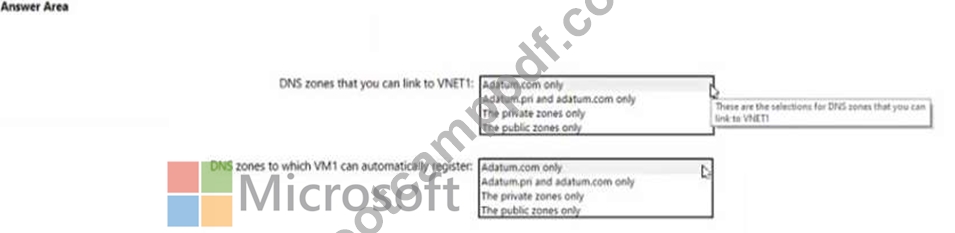
Answer:
Explanation:
Explanation
NEW QUESTION 95
Your on-premises network contains an SMB share named Share1.
You have an Azure subscription that contains the following resources:
A web app named webapp1
A virtual network named VNET1
You need to ensure that webapp1 can connect to Share1.
What should you deploy?
- A. an Azure Virtual Network Gateway
A Site-to-Site VPN gateway connection can be used to connect your on-premises network to an Azure virtual network over an IPsec/IKE (IKEv1 or IKEv2) VPN tunnel.
This type of connection requires a VPN device, a VPN gateway, located on-premises that has an externally facing public IP address assigned to it. - B. an Azure Active Directory (Azure AD) Application Proxy
- C. an Azure Application Gateway
Answer: A
Explanation:
Reference:
https://docs.microsoft.com/en-us/azure/vpn-gateway/vpn-gateway-howto-site-to-site-resource-manager-portal
NEW QUESTION 96
You need to the appropriate sizes for the Azure virtual for Server2.
What should you do? To answer, select the appropriate options in the answer area.
NOTE: Each correct selection is worth one point.
Answer:
Explanation:
References:
https://docs.microsoft.com/en-us/azure/site-recovery/migrate-tutorial-on-premises-azure
Topic 3, Contoso Ltd
Existing Environment
Currently, Contoso uses multiple types of servers for business operations, including the following:
File servers
Domain controllers
Microsoft SQL Server servers
Your network contains an Active Directory forest named contoso.com. All servers and client computers are joined to Active Directory.
You have a public-facing application named App1. App1 is comprised of the following three tiers:
A SQL database
A web front end
A processing middle tier
Each tier is comprised of five virtual machines. Users access the web front end by using HTTPS only.
Requirements
Planned Changes
Contoso plans to implement the following changes to the infrastructure:
Move all the tiers of App1 to Azure.
Move the existing product blueprint files to Azure Blob storage.
Create a hybrid directory to support an upcoming Microsoft Office 365 migration project.
Technical Requirements
Contoso must meet the following technical requirements:
Move all the virtual machines for App1 to Azure.
Minimize the number of open ports between the App1 tiers.
Ensure that all the virtual machines for App1 are protected by backups.
Copy the blueprint files to Azure over the Internet.
Ensure that the blueprint files are stored in the archive storage tier.
Ensure that partner access to the blueprint files is secured and temporary.
Prevent user passwords or hashes of passwords from being stored in Azure.
Use unmanaged standard storage for the hard disks of the virtual machines.
Ensure that when users join devices to Azure Active Directory (Azure AD), the users use a mobile phone to verify their identity.
Minimize administrative effort whenever possible.
User Requirements
Contoso identifies the following requirements for users:
Ensure that only users who are part of a group named Pilot can join devices to Azure AD.
Designate a new user named Admin1 as the service administrator of the Azure subscription.
Admin1 must receive email alerts regarding service outages.
Ensure that a new user named User3 can create network objects for the Azure subscription.
NEW QUESTION 97
You have an Azure subscription that contains an Azure Directory (Azure AD) tenant named contoso.com. The tenant is synced to the on-premises Active Directory domain. The domain contains the users shown in the following table.
You enable self-service password reset (SSPR) for all users and configure SSPR to have the following authentication methods:
* Number of methods required to reset: 2
* Methods available to users: Mobile phone, Security questions
* Number of questions required to register: 3
* Number of questions required to reset: 3
You select the following security questions:
* What is your favorite food?
* In what city was your first job?
* What was the name of your first pet?
For each of the following statements, select Yes if the statement is true. Otherwise, select No.
NOTE: Each correct selection is worth one point.
Answer:
Explanation:
Explanation
Box 1: No
Administrator accounts are special accounts with elevated permissions. To secure them, the following restrictions apply to changing passwords of administrators:
On-premises enterprise administrators or domain administrators cannot reset their password through Self-service password reset (SSPR). They can only change their password in their on-premises environment.
Thus, we recommend not syncing on-prem AD admin accounts to Azure AD.
An administrator cannot use secret Questions & Answers as a method to reset password.
Box 2: Yes
Self-service password reset (SSPR) is an Azure Active Directory feature that enables employees to reset their passwords without needing to contact IT staff.
Box 3: Yes
References:
https://docs.microsoft.com/en-us/azure/active-directory/authentication/howto-sspr-deployment
NEW QUESTION 98
You have an Azure subscription named Subscription1 that contains the quotas shown in the following table.
You deploy virtual machine to Subscription1 as shown in the following table.
You plan to deploy the virtual machines shown in the following table.
For each of the following statements, select Yes if the statement is true. Otherwise, select No.
Answer:
Explanation:
Explanation
The total regional vCPUs is 20 so that means a maximum total of 20 vCPUs across all the different VM sizes.
The deallocated VM with 16 vCPUs counts towards the total. VM20 and VM1 are using 18 of the maximum
20 vCPUs leaving only two vCPUs available.
Reference:
https://docs.microsoft.com/en-us/azure/virtual-machines/windows/quotas
NEW QUESTION 99
You have an Azure subscription that contains two virtual networks named VNet1 and VNet2. Virtual machines connect to the virtual networks.
The virtual networks n on-premises server named Server1 th
configured as shown in the following table.
You need to add the address space of 10.33.0.0/16 to VNet1. The solution must ensure that the hosts on VNet1 and VNet2 can communicate.
Which three actions should you perform in sequence? To answer, move the appropriate actions from the list of actions to the answer area and arrange them in the correct order.
Answer:
Explanation:
Explanation:
Step 1: Remove peering between Vnet1 and VNet2.
You can't add address ranges to, or delete address ranges from a virtual network's address space once a virtual network is peered with another virtual network. To add or remove address ranges, delete the peering, add or remove the address ranges, then re-create the peering.
Step 2: Add the 10.44.0.0/16 address space to VNet1.
Step 3: Recreate peering between VNet1 and VNet2
References:
https://docs.microsoft.com/en-us/azure/virtual-network/virtual-network-manage-peering
NEW QUESTION 100
You have an Azure subscription named Subscription1.
You create an Azure Storage account named contosostorage, and then you create a file share named data.
Which UNC path should you include in a script that references files from the data file share? To answer, drag the appropriate values to the correct targets. Each value may be used once, more than once, or not at all. You may need to drag the split bar between panes or scroll to view content.
NOTE: Each correct selection is worth one point.
Answer:
Explanation:
Explanation
Box 1: contosostorage
The name of account
Box 2: file.core.windows.net
Box 3: data
The name of the file share is data.
Example:
References: https://docs.microsoft.com/en-us/azure/storage/files/storage-how-to-use-files-windows
NEW QUESTION 101
HOTSPOT
You have an Azure File sync group that has the endpoints shown in the following table.
Cloud tiering is enabled for Endpoint3.
You add a file named File1 to Endpoint1 and a file named File2 to Endpoint2.
On which endpoints will File1 and File2 be available within 24 hours of adding the files? To answer, select the appropriate options in the answer area.
NOTE: Each correct selection is worth one point.
Hot Area:
Answer:
Explanation:
Section: [none]
Explanation:
File1: Endpoint3 only
Cloud Tiering: A switch to enable or disable cloud tiering. When enabled, cloud tiering will tier files to your Azure file shares. This converts on-premises file shares into a cache, rather than a complete copy of the dataset, to help you manage space efficiency on your server. With cloud tiering, infrequently used or accessed files can be tiered to Azure Files.
File2: Endpoint1, Endpoint2, and Endpoint3
Reference:
https://docs.microsoft.com/en-us/azure/storage/files/storage-sync-cloud-tiering
NEW QUESTION 102
You plan to use Azure Network Watcher to perform the following tasks:
* Task1: Identify a security rule that prevents a network packet from reaching an Azure virtual machine
* Task2: Validate outbound connectivity from an Azure virtual machine to an external host
Which feature should you use for each task? To answer, select the appropriate options in the answer area.
NOTE: Each correct selection is worth one point.
Answer:
Explanation:
Explanation:
Task 1: IP flow verify
The IP flow verify capability enables you to specify a source and destination IPv4 address, port, protocol (TCP or UDP), and traffic direction (inbound or outbound). IP flow verify then tests the communication and informs you if the connection succeeds or fails. If the connection fails, IP flow verify tells you which security rule allowed or denied the communication, so that you can resolve the problem.
Task 2: Connection troubleshoot
The connection troubleshoot capability enables you to test a connection between a VM and another VM, an FQDN, a URI, or an IPv4 address. The test returns similar information returned when using the connection monitor capability, but tests the connection at a point in time, rather than monitoring it over time.
Reference:
https://docs.microsoft.com/en-us/azure/network-watcher/network-watcher-monitoring-overview
https://docs.microsoft.com/en-us/azure/network-watcher/network-watcher-ip-flow-verify-overview
https://docs.microsoft.com/en-us/azure/network-watcher/network-watcher-connectivity-overview
NEW QUESTION 103
You create an Azure Storage account named contosostorage.
You plan to create a file share named data.
Users need to map a drive to the data file share from home computers that run Windows 10.
Which outbound port should you open between the home computers and the data file share?
- A. 0
- B. 1
- C. 2
- D. 3
Answer: A
Explanation:
Section: [none]
Explanation:
Server Message Block (SMB) is used to connect to an Azure file share over the internet. The SMB protocol requires TCP port 445 to be open.
Incorrect Answers:
A: Port 80 is required for HTTP to a web server
B: Port 443 is required for HTTPS to a web server
D: Port 3389443 is required for Remote desktop protocol (RDP) connections Reference:
https://docs.microsoft.com/en-us/azure/storage/files/storage-how-to-use-files-windows Testlet 2 Case study This is a case study. Case studies are not timed separately. You can use as much exam time as you would like to complete each case. However, there may be additional case studies and sections on this exam.
You must manage your time to ensure that you are able to complete all questions included on this exam in the time provided.
To answer the questions included in a case study, you will need to reference information that is provided in the case study. Case studies might contain exhibits and other resources that provide more information about the scenario that is described in the case study. Each question is independent of the other questions in this case study.
At the end of this case study, a review screen will appear. This screen allows you to review your answers and to make changes before you move to the next section of the exam. After you begin a new section, you cannot return to this section.
To start the case study
To display the first question in this case study, click the Next button. Use the buttons in the left pane to explore the content of the case study before you answer the questions. Clicking these buttons displays information such as business requirements, existing environment, and problem statements. If the case study has an All Information tab, note that the information displayed is identical to the information displayed on the subsequent tabs. When you are ready to answer a question, click the Question button to return to the question.
Overview
Contoso, Ltd. is a manufacturing company that has offices worldwide. Contoso works with partner organizations to bring products to market.
Contoso products are manufactured by using blueprint files that the company authors and maintains.
Existing Environment
Currently, Contoso uses multiple types of servers for business operations, including the following:
* File servers
* Domain controllers
* Microsoft SQL Server servers
Your network contains an Active Directory forest named contoso.com. All servers and client computers are joined to Active Directory.
You have a public-facing application named App1. App1 is comprised of the following three tiers:
* A SQL database
* A web front end
* A processing middle tier
Each tier is comprised of five virtual machines. Users access the web front end by using HTTPS only.
Requirements
Planned Changes
Contoso plans to implement the following changes to the infrastructure:
* Move all the tiers of App1 to Azure.
* Move the existing product blueprint files to Azure Blob storage.
* Create a hybrid directory to support an upcoming Microsoft Office 365 migration project.
Technical Requirements
Contoso must meet the following technical requirements:
* Move all the virtual machines for App1 to Azure.
* Minimize the number of open ports between the App1 tiers.
* Ensure that all the virtual machines for App1 are protected by backups.
* Copy the blueprint files to Azure over the Internet.
* Ensure that the blueprint files are stored in the archive storage tier.
* Ensure that partner access to the blueprint files is secured and temporary.
* Prevent user passwords or hashes of passwords from being stored in Azure.
* Use unmanaged standard storage for the hard disks of the virtual machines.
* Ensure that when users join devices to Azure Active Directory (Azure AD), the users use a mobile phone to verify their identity.
* Minimize administrative effort whenever possible.
User Requirements
Contoso identifies the following requirements for users:
* Ensure that only users who are part of a group named Pilot can join devices to Azure AD.
* Designate a new user named Admin1 as the service admin for the Azure subscription.
* Admin1 must receive email alerts regarding service outages.
* Ensure that a new user named User3 can create network objects for the Azure subscription.
NEW QUESTION 104
Note: This question is part of a series of questions that present the same scenario. Each question in the series contains a unique solution that might meet the stated goals. Some question sets might have more than one correct solution, while others might not have a correct solution.
After you answer a question in this section, you will NOT be able to return to it. As a result, these questions will not appear in the review screen.
You have an Azure subscription that contains 10 virtual networks. The virtual networks are hosted in separate resource groups.
Another administrator plans to create several network security groups (NSGs) in the subscription.
You need to ensure that when an NSG is created, it automatically blocks TCP port 8080 between the virtual networks.
Solution: You configure a custom policy definition, and then you assign the policy to the subscription.
Does this meet the goal?
- A. No
- B. Yes
Answer: B
Explanation:
Section: Configure and manage virtual networking
Explanation:
Resource policy definition used by Azure Policy enables you to establish conventions for resources in your organization by describing when the policy is enforced and what effect to take. By defining conventions, you can control costs and more easily manage your resources.
Reference:
https://docs.microsoft.com/en-us/azure/azure-policy/policy-definition
NEW QUESTION 105
You have an Azure subscription that contains the storage accounts shown in the following table.
You need to identify which storage account can be converted to zone-redundant storage (ZRS) replication by requesting a live migration from Azure support.
What should you identify?
- A. storage1
- B. storage2
- C. storage3
- D. storage4
Answer: B
Explanation:
ZRS currently supports standard general-purpose v2, FileStorage and BlockBlobStorage storage account types.
Incorrect Answers:
A, not C: Live migration is supported only for storage accounts that use LRS replication. If your account uses GRS or RA-GRS, then you need to first change your account's replication type to LRS before proceeding. This intermediary step removes the secondary endpoint provided by GRS/RA-GRS.
Also, only standard storage account types support live migration. Premium storage accounts must be migrated manually.
D: ZRS currently supports standard general-purpose v2, FileStorage and BlockBlobStorage storage account types.
Reference:
https://docs.microsoft.com/en-us/azure/storage/common/storage-redundancy-zrs
NEW QUESTION 106
You have an Azure subscription that contains an Azure Storage account.
You plan to create an Azure container instance named container1 that will use a Docker image namedImage1. Image1 contains a Microsoft SQL Server instance that requires persistent storage.
You need to configure a storage service for Container1.
What should you use?
- A. Azure Blob storage
- B. Azure Files
- C. Azure Table storage
- D. Azure Queue storage
Answer: C
NEW QUESTION 107
You have an Azure Active Directory (Azure AD) tenant named contoso.com. Multi-factor authentication (MFA) is enabled for all users.
You need to provide users with the ability to bypass MFA for 10 days on devices to which they have successfully signed in by using MFA.
What should you do?
- A. From Azure AD, create a conditional access policy.
- B. From the multi-factor authentication page, configure the users' settings.
- C. From the MFA blade in Azure AD, configure the MFA Server settings.
- D. From the multi-factor authentication page, configure the service settings.
Answer: D
Explanation:
Explanation
Enable remember Multi-Factor Authentication
* Sign in to the Azure portal.
* On the left, select Azure Active Directory > Users.
* Select Multi-Factor Authentication.
* Under Multi-Factor Authentication, select service settings.
* On the Service Settings page, manage remember multi-factor authentication, select the Allow users to remember multi-factor authentication on devices they trust option.
* Set the number of days to allow trusted devices to bypass two-step verification. The default is 14 days.
* Select Save.
References:
https://docs.microsoft.com/en-us/azure/active-directory/authentication/howto-mfa-mfasettings
NEW QUESTION 108
Note: This question is part of a series of questions that present the same scenario. Each question in the series contains a unique solution that might meet the stated goals. Some question sets might have more than one correct solution, while others might not have a correct solution.
After you answer a question in this section, you will NOT be able to return to it. As a result, these questions will not appear in the review screen.
You have an Azure subscription named Subscription1 that contains the resources shown in the following table.
VM1 connects to a virtual network named VNET2 by using a network interface named NIC1.
You need to create a new network interface named NIC2 for VM1.
Solution: You create NIC2 in RG2 and Central US.
Does this meet the goal?
- A. No
- B. Yes
Answer: A
Explanation:
Explanation
The virtual machine you attach a network interface to and the virtual network you connect it to must exist in the same location, here West US, also referred to as a region.
References:
https://docs.microsoft.com/en-us/azure/virtual-network/virtual-network-network-interface
NEW QUESTION 109
You have an Azure subscription. You need to transfer 34TB of data from an on-premise Windows 2016 server to your Azure storage account. You need to ensure that the data transfer has zero impact on the network, preserves your existing drives and is the fastest and most secure method. What should be your first step?
- A. Prepare your hard drives using the WAImportExport tool
- B. Open a ticket with Microsoft Support
- C. Start an Import Job via the Azure Portal
- D. Order an Azure Databox via the Azure Portal
Answer: D
Explanation:
Explanation
The Microsoft Azure Data Box cloud solution lets you send terabytes of data into and out of Azure in a quick, inexpensive, and reliable way.
https://docs.microsoft.com/en-us/azure/databox/data-box-overview
NEW QUESTION 110
......
Best updated resource for AZ-104 Online Practice Exam: https://www.bootcamppdf.com/AZ-104_exam-dumps.html
Realistic Practice AZ-104 Microsoft Azure Administrator Exam Braindumps: https://drive.google.com/open?id=1jgjzCkQ6JFzKAnzgxFwN8q0cEMjw1eER