


Verified & Correct SailPoint-Certified-IdentityNow-Engineer Practice Test Reliable Source Dec 10, 2025 Updated
Free SailPoint SailPoint-Certified-IdentityNow-Engineer Exam Files Downloaded Instantly
NEW QUESTION # 39
Is the following true about the web-services connector in IdentityNow?
Solution: The connector supports Basic Authentication.
- A. Yes
- B. No
Answer: A
Explanation:
Yes, the Web Services connector in SailPoint IdentityNow supports Basic Authentication. Basic Authentication is a standard method for securing API requests by sending credentials (username and password) encoded in the HTTP headers. This is a common practice for authenticating web service requests, and the Web Services connector in IdentityNow supports it along with other authentication methods like OAuth.
Reference:
SailPoint IdentityNow Web Services Connector Configuration Guide.
SailPoint IdentityNow Connector Authentication Methods Documentation.
NEW QUESTION # 40
A customer wants to configure a virtual appliance (VA) to use a static IP address. Does this file on the VA need to be modified to perform the configuration?
Solution: /home/sailpoint/config.yaml
- A. Yes
- B. No
Answer: B
Explanation:
The /home/sailpoint/config.yaml file is not used to configure the Virtual Appliance (VA) to use a static IP address. This file is generally used for other configuration purposes related to the SailPoint IdentityNow application settings, not for network configurations like setting static IP addresses.
Network configurations are handled at the system or network service level within the VA's Linux environment.
Reference:
SailPoint IdentityNow Virtual Appliance Configuration Guide.
SailPoint IdentityNow Networking Configuration Documentation.
NEW QUESTION # 41
The customer has a system that matches the following description. Is this a suitable connector type to use?
The system is a modern, cloud-based, web application that uses a MySQL database backend provided by the cloud platform. The database is only accessible from the web application. The web application exposes a fully compliant SCIM 2.0 interface with OAuth 2.0 client credentials.
Solution: SCIM 2.0 Connector
- A. Yes
- B. No
Answer: A
Explanation:
Yes, the SCIM 2.0 Connector is the most suitable connector for this use case. The system described is a modern, cloud-based web application that exposes a fully compliant SCIM 2.0 interface and uses OAuth 2.0 client credentials for authentication. SCIM (System for Cross-domain Identity Management) is a standardized protocol designed to simplify identity management in cloud applications. The SCIM 2.0 Connector in SailPoint IdentityNow is specifically built to integrate with systems that provide a SCIM interface, making it the ideal connector for this scenario.
Reference:
SailPoint IdentityNow SCIM 2.0 Connector Guide.
SailPoint IdentityNow Cloud-Based Integration Documentation.
NEW QUESTION # 42
Review the sentence below
The virtual appliance (VA) private key is_____.
Does this option correctly complete the sentence?
Solution: Stored both in the identityNow tenant and on the VA.
- A. Yes
- B. No
Answer: B
Explanation:
The virtual appliance (VA) private key is not stored in both the IdentityNow tenant and the VA. The VA private key, which is critical for secure communications, is stored only on the Virtual Appliance (VA) itself. It is used to authenticate and encrypt communications between the VA and the IdentityNow tenant. Storing such sensitive information in the IdentityNow tenant would violate best practices for key management and security.
Instead, the IdentityNow tenant only holds the public key or a reference to the key to facilitate secure exchanges with the VA. The private key remains secured locally within the VA, protecting it from potential security vulnerabilities associated with external storage.
Reference:
SailPoint IdentityNow Virtual Appliance Architecture Guide.
SailPoint IdentityNow Security and Encryption Documentation.
NEW QUESTION # 43
An engineer needs to troubleshoot the following issue:
Incomplete Identities on authoritative source
Is this a reasonable action for the engineer to take?
Solution: Download the identity Exceptions report from the identity profile page.
- A. Yes
- B. No
Answer: A
Explanation:
Yes, downloading the Identity Exceptions report from the identity profile page is a reasonable and recommended action when troubleshooting incomplete identities on an authoritative source. This report provides detailed information about any issues or exceptions encountered during identity aggregation, such as missing required attributes or mapping errors. Analyzing this report can help identify the root cause of incomplete identity records and assist in resolving those issues.
Reference:
SailPoint IdentityNow Identity Profile Configuration and Troubleshooting Guide.
SailPoint IdentityNow Exception Handling and Reporting Documentation.
NEW QUESTION # 44
Is the following true about custom connectors in IdentityNow?
Solution: Custom connector configurations can have account correlation settings defined.
- A. Yes
- B. No
Answer: A
Explanation:
Yes, custom connector configurations in SailPoint IdentityNow can have account correlation settings defined. Account correlation is used to link accounts from different sources to the correct identity in IdentityNow. When configuring a custom connector, it is possible to define how accounts from the connected system are correlated to existing identities based on attributes like usernames or other unique identifiers.
Key Reference from SailPoint Documentation:
Custom Connector Configuration: SailPoint allows for the definition of account correlation settings in custom connectors to ensure proper linking of external accounts to internal identities.
NEW QUESTION # 45
Does this example accurately describe an IdentityNow data flow?
Solution:
1. An IdentityNow engineer clicks "start manual aggregation".
2. The IdentityNow tenant contacts the Active Directory domain controller.
3. The domain controller sends a list of accounts to the virtual appliance.
4. The virtual appliance masks sensitive information and sends a list of accounts to the IdentityNow tenant.
- A. Yes
- B. No
Answer: B
Explanation:
No, this example does not accurately describe an IdentityNow data flow. The step where the domain controller sends a list of accounts directly to the virtual appliance is incorrect. Instead, during manual aggregation, the virtual appliance is responsible for initiating the connection to the domain controller (or other authoritative source), retrieving account data, and then sending the results to the IdentityNow tenant. Sensitive information is masked before sending the data from the virtual appliance to the IdentityNow tenant, but the domain controller does not interact directly with the IdentityNow tenant.
Reference:
SailPoint IdentityNow Aggregation Process Documentation.
SailPoint IdentityNow Virtual Appliance Data Flow Guide.
NEW QUESTION # 46
Is this statement true about using the IdentityNow APIs?
Solution: API documentation is located at https://docs.sailpoint.com
- A. Yes
- B. No
Answer: A
Explanation:
SailPoint IdentityNow API documentation is indeed located at https://docs.sailpoint.com. This official documentation site contains all the information developers need to interact with IdentityNow through APIs. It includes guidelines on how to authenticate, make requests, and use the API endpoints to automate and integrate with other systems.
Key Reference from SailPoint Documentation:
SailPoint API Documentation: The site docs.sailpoint.com hosts the official API documentation for SailPoint IdentityNow, covering all aspects of using IdentityNow's APIs.
NEW QUESTION # 47
Does the following use case correctly describe passthrough authentication?
Solution: A user logs into identityNow using a password set in identityNow during registration.
- A. Yes
- B. No
Answer: B
Explanation:
Passthrough authentication in SailPoint IdentityNow refers to a method where the authentication process happens through a trusted identity provider (IdP), rather than using credentials stored directly in SailPoint IdentityNow. The key feature of passthrough authentication is that the user's login attempt is authenticated via external authentication mechanisms such as Active Directory, SAML-based Identity Providers (IdPs), or other federated identity providers.
In the given use case, the user is logging into IdentityNow using a password set directly in IdentityNow during registration. This process describes local authentication (where IdentityNow manages the credentials), not passthrough authentication. Since passthrough authentication relies on external IdPs or federated systems, this case does not accurately describe passthrough authentication.
Reference:
SailPoint IdentityNow Documentation on Authentication Methods.
SailPoint IdentityNow Federation and SSO Configuration Guides.
NEW QUESTION # 48
Exhibit.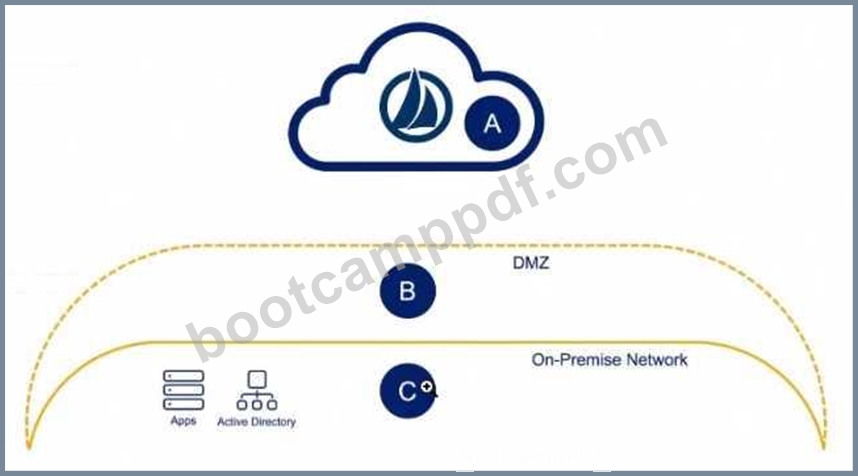
Solution: An engineer has one small production data center with an Active Directory, a database server, and two cloud applications to which they need to connect Where would the virtual appliances (VAs) reside In this scenario?
Solution: C
- A. Yes
- B. No
Answer: A
Explanation:
Yes, the Virtual Appliances (VAs) should reside in C, which represents the on-premise network. In this scenario, the engineer has an Active Directory, a database server, and cloud applications. The VA needs to reside inside the internal on-premises network (C) to securely communicate with the Active Directory and database server. The VA will manage the secure connection to these internal resources and can also interact with cloud applications via SailPoint IdentityNow.
Key Reference from SailPoint Documentation:
VA Deployment in On-Prem Network: SailPoint advises deploying Virtual Appliances within the internal on-premises network where they can securely access identity sources like Active Directory and internal databases.
NEW QUESTION # 49
An IdentityNow engineer needs to find identities with disabled AD accounts by using IdentityNow's search features. Is this the correct search syntax to perform this task?
Solution:
- A. Yes
- B. No
Answer: A
Explanation:
Yes, the search syntax @accounts( source.name:"AD" AND state:"disabled" ) is correct, as it matches the necessary criteria for finding disabled AD accounts. This query searches for accounts in the AD source where the account state is set to "disabled," which effectively filters for the desired result.
Key Reference from SailPoint Documentation:
Correct Syntax for Disabled Accounts: The search correctly identifies accounts with a disabled state using this syntax.
NEW QUESTION # 50
Is this statement correct about security and/or encryption of data?
Solution: identityNow uses a hashing algorithm for secure encryption of data in transit and uses TLS for hashing passwords and the answers to security questions
- A. Yes
- B. No
Answer: B
Explanation:
No, this statement is incorrect. While IdentityNow does use TLS (Transport Layer Security) for securing data in transit, TLS is not a hashing algorithm; it is a protocol used for encryption to ensure secure communication over networks. Additionally, IdentityNow uses hashing algorithms for securely storing passwords and answers to security questions (e.g., SHA-256 or bcrypt), but it does not use TLS for hashing these values. Hashing algorithms are one-way functions that help store sensitive data securely by converting them into irreversible fixed-length representations.
TLS protects data during transmission by encrypting it, while hashing is used for securing stored data such as passwords.
Reference:
SailPoint IdentityNow Encryption and Security Practices Documentation.
SailPoint IdentityNow Password Hashing and Encryption Mechanisms Guide.
NEW QUESTION # 51
An engineer needs to troubleshoot the following issue:
Incomplete Identities on authoritative source
Is this a reasonable action for the engineer to take?
Solution: Review the All Source Activity report available in Search.
- A. Yes
- B. No
Answer: A
Explanation:
Yes, reviewing the All Source Activity report available in Search is a reasonable action when troubleshooting incomplete identities. This report provides an overview of activity related to source systems, including account aggregations, transformations, and data flow from the source to IdentityNow. By reviewing this report, engineers can identify potential issues such as failed aggregations, data errors, or problems with source connectivity that might be causing incomplete identities.
Reference:
SailPoint IdentityNow Source Activity Reports Documentation.
SailPoint IdentityNow Troubleshooting Aggregation and Source Issues Guide.
NEW QUESTION # 52
Is this statement accurate regarding SailPoint's multi-tenant processing environment?
Solution: identityNow admins have the option to choose how often updates to their tenant occur.
- A. Yes
- B. No
Answer: B
Explanation:
No, IdentityNow administrators do not have the option to choose how often updates to their tenant occur. As part of SailPoint's multi-tenant SaaS platform, updates are managed and controlled by SailPoint and are pushed out automatically to all tenants. Administrators do not have the ability to schedule or defer updates, as this ensures all customers are running on the latest and most secure version of the software.
Reference:
SailPoint IdentityNow SaaS Release and Update Policy.
SailPoint IdentityNow Multi-Tenant Environment Overview.
NEW QUESTION # 53
Is the following statement accurate regarding Separation of Duties (SoD)?
Solution: An SoD policy can define mitigating controls.
- A. Yes
- B. No
Answer: A
Explanation:
Yes, an SoD policy can define mitigating controls. Mitigating controls are measures put in place to reduce the risk of having conflicting duties. For example, if it's not possible to completely segregate duties due to resource constraints or other business factors, mitigating controls such as enhanced auditing, periodic reviews, or dual approvals can be defined to manage the risk. SailPoint IdentityNow allows for the creation of SoD policies that include such mitigating controls to ensure compliance with security and governance requirements.
Key Reference from SailPoint Documentation:
Mitigating Controls in SoD Policies: SailPoint supports the definition of mitigating controls within SoD policies to manage and reduce risks when full separation of duties cannot be achieved.
NEW QUESTION # 54
Is this an item that an IdentityNow engineer should configure when implementing a source that uses a JDBC connector?
Solution: This item is complete
- A. Yes
- B. No
Answer: B
Explanation:
No, the statement "This item is complete" is vague and does not represent any actionable configuration when implementing a JDBC connector. An IdentityNow engineer needs to focus on specific technical configurations like setting up schemas, defining SQL queries, mapping attributes, and ensuring the correct service account permissions. Simply stating "This item is complete" is not a valid step in the implementation process.
Reference:
SailPoint IdentityNow JDBC Connector Implementation Checklist.
SailPoint IdentityNow Configuration and Implementation Documentation.
NEW QUESTION # 55
Is this the recommended way to test lifecycle state transitions in IdentityNow?
Solution: Configure and enable lifecycle states. Find a test identity that is not in the target lifecycle state. Manually change the test identity lifecycle state to the target state from the admin user interface Verify the results of the lifecycle slate in the identity's activity page.
- A. Yes
- B. No
Answer: A
Explanation:
Yes, this is the recommended way to test lifecycle state transitions in IdentityNow. To validate how lifecycle states function, administrators can manually set up and enable lifecycle states for testing purposes. By selecting a test identity that is not already in the target state, manually transitioning that identity to the target state using the admin user interface provides a direct and controlled way to observe the transition. The results can be verified in the identity's activity page, where changes in the lifecycle state will be logged, helping to ensure that the lifecycle state functions as expected.
Reference:
SailPoint IdentityNow Lifecycle Manager Documentation.
SailPoint IdentityNow Lifecycle State Configuration Guide.
NEW QUESTION # 56
Review the following transform:
Can the following output of this transform be expected, based on the input provided in the option?
Solution:
- A. Yes
- B. No
Answer: A
Explanation:
The provided transform is of type "Concat", which means it concatenates values from multiple sources. In this case, it appears to be concatenating the "cn" value with the "displayName" attribute of an identity. The "type": "IdentityAttribute" section specifies that the transform is pulling the
"displayName" attribute from the identity object.
Given the input where the displayName is "Thomas Miller", the expected output is in the format cn=Thomas Miller,ou=users,dc=example, which aligns with the displayed output in the example. The transformation concatenates the displayName value with the rest of the distinguished name (DN), which is a common use case for generating a DN from user attributes.
Key Reference from SailPoint Documentation:
Concat Transform in IdentityNow: The concat transform is used to join multiple attribute values, and in this example, it successfully creates the expected DN string using the provided displayName input.
NEW QUESTION # 57
Is this statement true about certification campaigns?
Solution: A certification item can be reassigned multiple times.
- A. Yes
- B. No
Answer: A
Explanation:
Yes, a certification item can be reassigned multiple times during a certification campaign. If a reviewer is unable to certify an item or needs another individual to review the access, they can reassign the certification to a different reviewer. This reassignment functionality allows flexibility in handling access certifications and ensuring the right person evaluates the access. There are no limits on how many times an item can be reassigned, making it a versatile feature within the certification process.
Reference:
SailPoint IdentityNow Certification Reassignment Feature Documentation.
SailPoint IdentityNow Certification Workflow Guide.
NEW QUESTION # 58
A customer wants to configure a virtual appliance (VA) to use a static IP address. Does this file on the VA need to be modified to perform the configuration?
Solution: /home/sailpoint/proxy.yaml
- A. Yes
- B. No
Answer: B
Explanation:
The /home/sailpoint/proxy.yaml file is used for proxy settings, not for configuring the Virtual Appliance to use a static IP address. This file is typically modified to configure outbound proxy settings for the VA if it needs to route traffic through a proxy server. Static IP address configuration is handled elsewhere, at the operating system or network configuration level.
Reference:
SailPoint IdentityNow Virtual Appliance Proxy Configuration Documentation.
SailPoint IdentityNow Network Settings Documentation.
NEW QUESTION # 59
Is the following true about the web-services connector in IdentityNow?
Solution: The connector supports SAML authentication.
- A. Yes
- B. No
Answer: B
Explanation:
The Web Services connector in SailPoint IdentityNow does not support SAML authentication. SAML is primarily used for Single Sign-On (SSO) authentication for web applications, whereas the Web Services connector in IdentityNow typically supports Basic Authentication, OAuth, or custom header- based authentication for API-based integrations. SAML authentication is generally used for federated identity management rather than for API-based interactions.
Reference:
SailPoint IdentityNow Web Services Connector Configuration Guide.
SailPoint IdentityNow Authentication Methods for Connectors.
NEW QUESTION # 60
An IdentityNow engineer has the following problem:
An identity is listed under Identities with Errors.
Is this one of the steps that should be taken to troubleshoot the issue?
Solution: Check for missing lastname, email, or uid attributes.
- A. Yes
- B. No
Answer: A
Explanation:
Yes, checking for missing critical attributes like lastname, email, or uid is a valid step when troubleshooting an identity listed under "Identities with Errors" in SailPoint IdentityNow. These attributes are often required for proper identity processing, synchronization, and provisioning. If any of these attributes are missing or incorrectly configured, it could result in errors, preventing the identity from being fully processed by the system.
Key Reference from SailPoint Documentation:
Identity Attributes and Error Handling: SailPoint IdentityNow requires certain core identity attributes (such as lastname, email, uid) to be present and correctly populated. Missing or invalid values for these attributes can lead to errors and prevent identity synchronization or provisioning.
NEW QUESTION # 61
An engineer needs to troubleshoot the following issue:
Incomplete Identities on authoritative source
Is this a reasonable action for the engineer to take?
Solution: Download the accounts data csv from the Account tab on the authoritative source.
- A. Yes
- B. No
Answer: A
Explanation:
Yes, downloading the accounts data CSV from the Accounts tab on the authoritative source is a reasonable action for troubleshooting incomplete identities. This CSV file contains detailed account information pulled from the authoritative source, allowing the engineer to manually inspect the raw data and identify any discrepancies or missing attributes that could lead to incomplete identities.
This is a useful step in verifying the accuracy and completeness of the data being aggregated from the authoritative source.
Reference:
SailPoint IdentityNow Source Account Data Inspection and CSV Export Documentation.
SailPoint IdentityNow Identity Data Troubleshooting Guide.
NEW QUESTION # 62
An IdentityNow engineer has set up an access profile for an application. The access profile allows for users to request access, and for a user's manager to approve or deny access.
After a recent staff meeting, management has expressed that they want to remove any approval requirements for this application.
Is management's request possible in IdentityNow. and. if so. are these the recommended steps the engineer should take to meet their new requirement?
Solution: It is possible. Delete the access profile.
- A. Yes
- B. No
Answer: B
Explanation:
No, deleting the access profile is not the correct way to meet the requirement of removing approval for access requests. The access profile defines the entitlements and permissions that users can request for an application. Deleting it would remove the entire ability to request access, rather than just removing the approval workflow. The correct step would be to modify the approval settings in the access profile (as explained in Question 44), not to delete it.
Key Reference from SailPoint Documentation:
Access Profile Management: Modifying approval settings in the access profile is the appropriate step to meet management's new requirement, not deleting the profile itself.
NEW QUESTION # 63
Is this an example of a vanity URL?
Solution: https://identityNowacme.com
- A. Yes
- B. No
Answer: B
Explanation:
https://identityNowacme.com is not typically considered a vanity URL. While it includes the
"identityNow" term, it does not appear to follow the format of a vanity URL, which generally includes a company-specific subdomain (like my) and a custom domain (example.com). In this case, the URL is more generic and lacks the branding or simplicity typically associated with vanity URLs.
Key Reference from SailPoint Documentation:
Vanity URL Structure in IdentityNow: Vanity URLs typically feature a customized subdomain that reflects the organization's branding, and identityNowacme.com does not fit this pattern.
NEW QUESTION # 64
......
Pass SailPoint SailPoint-Certified-IdentityNow-Engineer exam Dumps 100 Pass Guarantee With Latest Demo: https://www.bootcamppdf.com/SailPoint-Certified-IdentityNow-Engineer_exam-dumps.html
The SailPoint-Certified-IdentityNow-Engineer PDF Dumps Greatest for the SailPoint Exam Study Guide!: https://drive.google.com/open?id=1ldzS-MOsw-Zc9sq5jNuwB19VmaWcf-NU