


Get Feb-2026 Download Latest & Valid Questions For Cisco 300-540 exam
Ensure Success With Updated Verified 300-540 Exam Dumps
NEW QUESTION # 98
Direct Connect as a WAN infrastructure connectivity option is preferable for scenarios requiring:
- A. Low security and high latency
- B. Public internet access to cloud resources
- C. Minimal bandwidth and maximum costs
- D. High throughput and low latency
Answer: D
NEW QUESTION # 99
What does NFV stand for?
- A. Network Function Virtualization
- B. Network Function Visualization
- C. New Function Virtualization
- D. Network File Versioning
Answer: A
NEW QUESTION # 100 
Refer to the exhibit. An engineer must configure an IPsec VPN connection between site 1 and site 2. The ISAKMP policy for the phase 1 negotiations of the tunnel must use AES and SHA-256. This configuration was applied to both PE routers; however, the tunnel fails to come up:
crypto isakmp policy 10
encryption 3des
hash md5
authentication pre-share
group 12
Which two commands must be run on router PE1 to resolve the issue? (Choose two.)
- A. group 10
- B. hash sha256
- C. encryption sha256
- D. hash aes
- E. encryption aes
Answer: B,E
Explanation:
Phase 1 of an IPsec tunnel (ISAKMP/IKE) must havematching proposalson both peers for:
* Encryption algorithm
* Hash (integrity) algorithm
* Authentication method
* DH group
The requirement states thatAESandSHA-256must be used. The current configuration uses:
* encryption 3des # incorrect (must be AES)
* hash md5 # incorrect (must be SHA-256)
To meet the requirement, we must modify the ISAKMP policy:
crypto isakmp policy 10
encryption aes # change 3DES to AES
hash sha256 # change MD5 to SHA-256
authentication pre-share
group 12
Therefore, the necessary commands on PE1 are:
* encryption aes# optionB
* hash sha256# optionE
Options C and D are invalid syntax (encryption sha256 and hash aes are not supported). Changing the DH group (A) is not required by the problem statement and would not by itself fix the mismatch related to encryption and hash algorithms.
NEW QUESTION # 101
An engineer must design a pay-as-you-go solution for their partners. The solution must allow for rapid deployments, be flexible, and scale resources up or down in a hybrid workplace. What must be used?
- A. Cisco+ Hybrid Cloud for Virtualization
- B. Cisco+ Hybrid Cloud for Service Provider Networking
- C. Cisco+ Hybrid Cloud for Bare Metal Compute
- D. Cisco+ Hybrid Cloud for Virtual Desktop Infrastructure
Answer: D
Explanation:
Comprehensive and Detailed Explanation From Exact Extract from my knowledge of Designing and Implementing Cisco Service Provider Cloud Network Infrastructure Outlines without Any External URL or Links:
Cisco+ Hybrid Cloud is Cisco's as-a-service consumption model that offers pay-as-you-go infrastructure. For ahybrid workplace, the focus is on giving users secure desktop environments from anywhere, with the ability torapidly deployandscale up or downbased on the number of users or partners.
Cisco+Hybrid Cloud for Virtual Desktop Infrastructure (VDI)specifically delivers desktop and app workspaces as an on-demand service. It allows partners to consume desktops elastically, paying for capacity as needed and scaling the underlying compute, storage, and networking without rebuilding the environment.
* Bare Metal Compute and Virtualization offers flexible infrastructure but are aimed at app/workload hosting rather than user desktop workspaces.
* Service Provider Networking addresses network services, not end-user hybrid workplace desktops.
Therefore, for a pay-as-you-go, rapidly deployable, elastic solution in a hybrid workplace,Cisco+ Hybrid Cloud for Virtual Desktop Infrastructureis the correct choice.
NEW QUESTION # 102
In the context of cloud deployments, hybrid refers to:
- A. The use of both physical and virtual network functions
- B. A combination of Linux and Windows servers
- C. A mix of on-premises and off-premises infrastructure
- D. Deployments that mix SaaS and IaaS service models
Answer: C
NEW QUESTION # 103
SR-IOV is used in VNF optimization to:
- A. Reduce network virtualization benefits
- B. Provide direct virtual function access to improve performance
- C. Monitor physical network connections
- D. Encrypt data traffic
Answer: B
NEW QUESTION # 104
Control plane high availability within a single VIM is crucial for maintaining __________.
- A. stability
- B. scalability
- C. security
- D. performance
Answer: A
NEW QUESTION # 105 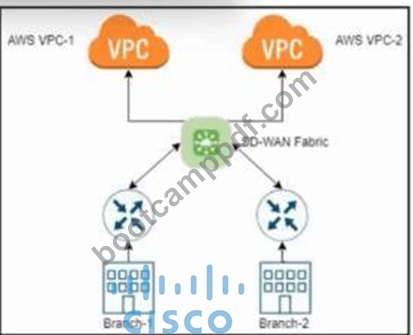
Refer to the exhibit. An engineer must design a solution that allows a user to choose which private Cisco Catalyst SD-WAN network they want to connect to AWS. The solution must automatically identify the AWS VPC and other cloud services based on the user credentials. What must be used?
- A. IPsec VPN
- B. Segment routing
- C. Transit VPC for AWS
- D. AWS Direct Connect
Answer: C
Explanation:
In Cisco Catalyst SD-WAN cloud integration, when the requirement is:
* Automatically discovering AWSVPCs
* Automatically identifying AWSservices
* Allowing the user to choose whichprivate SD-WAN networkconnects to the cloud
* UsingAWS credentials(Access Key / Secret Key) for automatic provisioning
...the Cisco-supported mechanism is theCisco SD-WAN Transit VPC solution.
Why Transit VPC is the correct answer:
* It is specifically designed to integrateCisco SD-WANwith AWS environments.
* Uses AWS APIs and user credentials to automatically discover:
* VPC IDs
* Subnets
* Regions
* Routing tables
* Automatically deploys and configures CSR1000v or Catalyst 8000V routers into the VPC.
* Provides a centralized "hub" in AWS to interconnect multiple SD-WAN sites.
* Enables the user to choose which SD-WAN segments connect to which VPCs.
This matches the requirement ofautomatic cloud resource identification based on user credentials.
Why the other options are incorrect
A). AWS Direct Connect
* This is a physical/private Layer 2 cloud connection.
* It doesnotauto-discover VPCs or integrate through credentials.
* It does not provide automated SD-WAN service provisioning.
C). IPsec VPN
* Works for connectivity but ismanual, not automated.
* Does not identify AWS cloud resources via credentials.
D). Segment routing
* A transport technology used inside SP networks, irrelevant to AWS API-based VPC discovery.
Thus, onlyTransit VPCprovides automatic AWS cloud discovery and integration with SD-WAN.
NEW QUESTION # 106
An engineer must implement a public cloud solution that enables a company to place all its infrastructureand its end-user applications in the cloud, eliminating the need for software application management and maintenance. Which cloud service model must be used?
- A. SaaS
- B. IaaS
- C. FaaS
- D. PaaS
Answer: A
Explanation:
Comprehensive and Detailed Explanation (Cisco Cloud Model Knowledge)
The requirement states:
* All infrastructure in the cloud
* All applications delivered from the cloud
* No software management
* No maintenance by the customer
This matchesSoftware as a Service (SaaS).
SaaS provides:
* Fully managed applications
* No patching, upkeep, installation, or infrastructure maintenance
* End-to-end cloud delivery
PaaS and IaaS still require some software/application management.
FaaS is event-driven serverless compute, not full application hosting.
Therefore, the correct answer isA. SaaS.
NEW QUESTION # 107
A common DoS mitigation technique is:
- A. Using a single firewall
- B. Removing all filters
- C. Rate limiting
- D. Increasing bandwidth
Answer: C
NEW QUESTION # 108
In the context of high availability, EVLAG is implemented to enhance __________.
- A. latency
- B. speed
- C. redundancy
- D. simplicity
Answer: C
NEW QUESTION # 109
Network segmentation is critical in a cloud environment for:
- A. Simplifying network topology
- B. Limiting the spread of breaches and attacks
- C. Enhancing performance by reducing security
- D. Enabling unrestricted access between zones
Answer: B
NEW QUESTION # 110
Virus detectors are used to:
- A. Manage user access
- B. Monitor network bandwidth
- C. Encrypt traffic
- D. Identify and eliminate malware
Answer: D
NEW QUESTION # 111
Equal-Cost Multi-Path (ECMP) routing is used to:
- A. Decrease bandwidth between NFVI and physical infrastructure
- B. Increase the cost of network infrastructure
- C. Ensure a single path for data flow to increase security
- D. Provide multiple paths for data to increase redundancy and load balancing
Answer: D
NEW QUESTION # 112
Direct connect and MPLS differ in that:
- A. Direct connect is a routing protocol
- B. MPLS can only be used in public internet connections
- C. Direct connect offers private connectivity to cloud services, while MPLS provides a protocol for efficient network routing
- D. MPLS offers direct access to cloud providers
Answer: C
NEW QUESTION # 113
EVPN over SR/MPLS provides advantages over traditional MPLS in terms of:
- A. Scalability and flexibility
- B. Security vulnerabilities
- C. Speed of deployment
- D. Cost only
Answer: A,C
NEW QUESTION # 114
Which cloud service model would best suit an organization looking to host its own web applications?
- A. IaaS
- B. PaaS
- C. FaaS
- D. SaaS
Answer: B
NEW QUESTION # 115
A large company's legacy network is set up with equipment from multiple vendors. The company engaged a network architect to optimize the network for virtualization. The architect must ensure robust and efficient operation, considering the company's immediate needs but also anticipating future network complexities and scalability requirements. The chosen strategy must be capable of integrating seamlessly with existing systems, while providing a pathway for innovation and growth. The solution must facilitate end-to-end service automation throughout the entire lifecycle, and the implementation must ensure the validation, execution, and abstraction of network configurations and services. Which action must be taken to meet the requirements?
- A. Implement a flexible service-modeling approach that leverages automation for ongoing management and refinement as demands on the network evolve.
- B. Implement a configuration-management approach that allows for configuring each network device individually to optimize its performance.
- C. Implement a service-modeling approach with a static YANG one-size-fits-all model that includes the unique requirements of each different network element.
- D. Implement a service life-cycle approach with simplified monitoring that plans for post-deployment adjustments to be incorporated into the automation CI/CD pipeline.
Answer: A
Explanation:
Cisco NSO-based orchestration principles in a multi-vendor environment require:
Service modeling using flexible, reusable YANG models
Abstraction of vendor-specific device differences
Transaction-safe configuration validation and execution
End-to-end automation across lifecycle stages (Day-0, Day-1, Day-N)
Scalability and adaptability for evolving requirements
Option C aligns perfectly with NSO service-modeling approaches:
Service models must be flexible, not rigid, enabling changes as technologies and needs evolve.
The architecture must support continuous refinement, enabling multi-vendor abstraction and lifecycle automation.
This ensures the network evolves seamlessly while remaining stable and automated.
Why the Other Options Are Incorrect
A - Simplified monitoring and post-deployment adjustments do not meet the core need for full lifecycle service modeling and abstraction.
B - Configuring devices individually contradicts the entire purpose of orchestration and abstraction.
D - A static YANG model cannot accommodate multi-vendor environments or future scalability.
Thus, only Option C matches full NSO-capable service modeling requirements.
NEW QUESTION # 116
......
Exam Materials for You to Prepare & Pass 300-540 Exam: https://www.bootcamppdf.com/300-540_exam-dumps.html
Pass Your 300-540 Exam at the First Try with 100% Real Exam: https://drive.google.com/open?id=1GG3iovwjiJoOJpG79vDdhsK0pY8h40c5